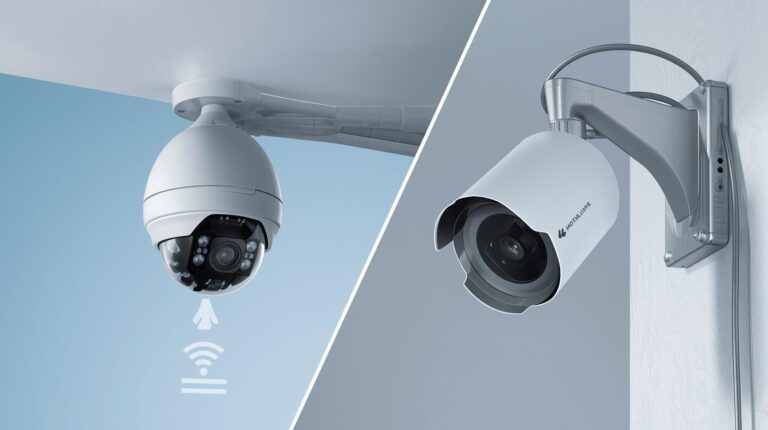
Wireless vs Wired CCTV: which option is best for your home? This is one of the first questions buyers ask when planning a CCTV installation. While both systems offer reliable security, the right choice depends on your property, budget, and monitoring needs.
Should you choose a wired system or a wireless one for your home? Your neighbour says wired is more reliable. Your cousin says wireless is easier to set up. The salesman at the shop says both are great (which means he wants to sell you whatever is in stock).
In this guide, we break down the differences in plain language. In addition, we focus on what matters most to Indian homeowners, in cities like Mumbai, Pune, Delhi, and Bangalore.
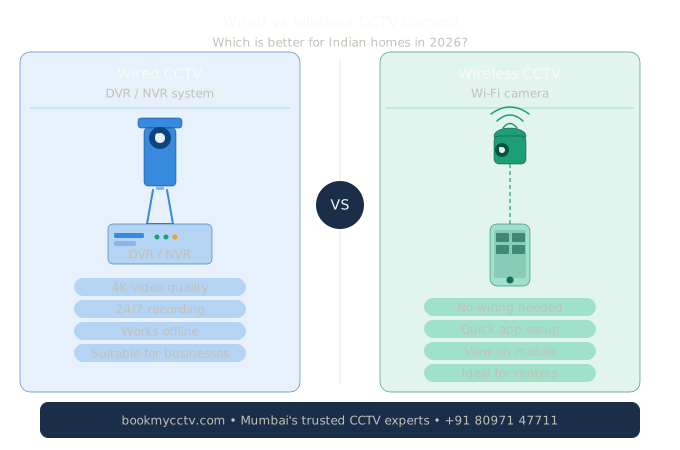
Wired vs Wireless CCTV at a Glance
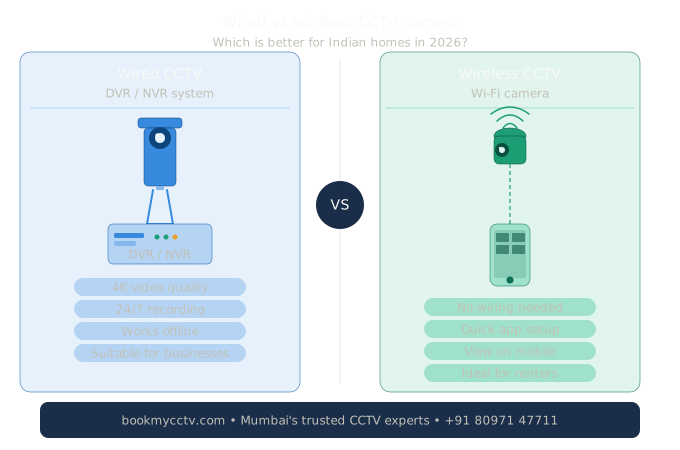
Pick WIRED if:
- Home or office ownership allows permanent installation
- 24/7 recording is required even when the internet is down
- More than 4 cameras are needed across multiple rooms
- Running a shop, office, or business requires continuous monitoring
- Footage may be needed as legal evidence
Pick WIRELESS if:
- Living in a rented flat where drilling is not allowed
- Only 1–3 cameras are needed for basic monitoring
- Fast and easy setup is a priority
- Frequent travel makes mobile alerts more important
- Trying CCTV for the first time on a limited budget
TABLE OF CONTENTS
1. Wireless vs Wired CCTV: What Is a Wired CCTV System?
2. Wireless vs Wired CCTV: What Is a Wireless CCTV System?
3. Wireless vs Wired CCTV: 10 Key Differences
4. Wireless vs Wired CCTV for Indian Homes
5.Wireless vs Wired CCTV Pros and Cons
6. Wireless vs Wired CCTV: Which Is Better for Indian Homes?
7. TOP PICKS FROM BOOKMYCCTV
8. Frequently Asked Questions
9. Wireless vs Wired CCTV: Final Verdict
Wireless vs Wired CCTV: What Is a Wired CCTV System?
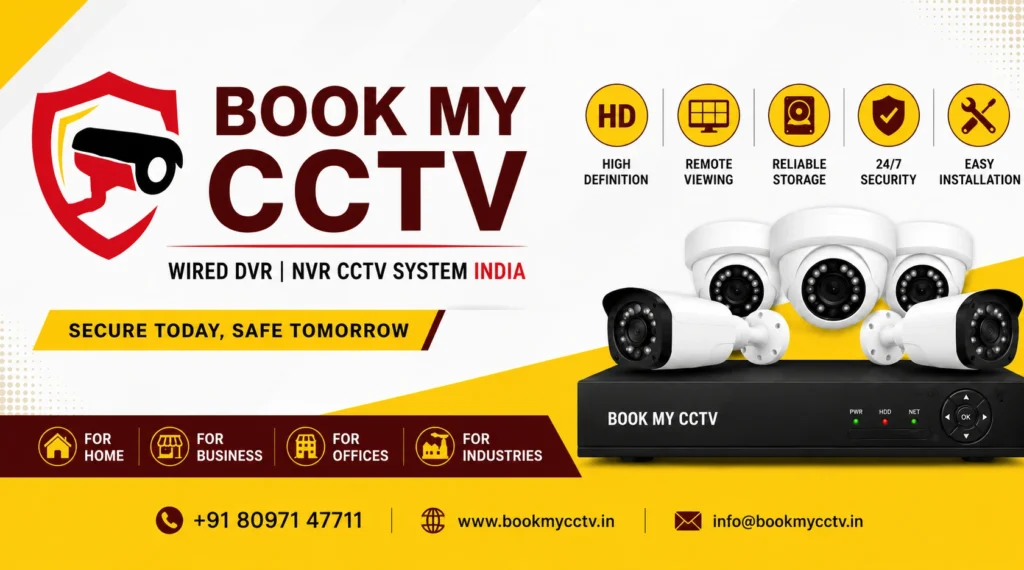
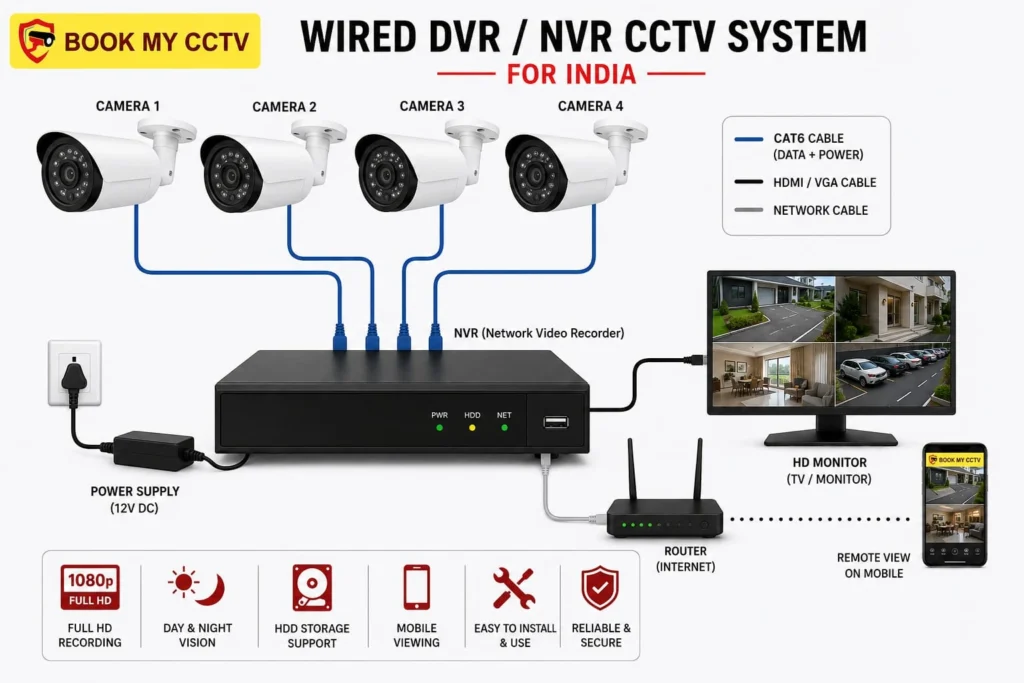
A wired CCTV system connects cameras to a recording device. It uses physical cables. There are two types depending on the cameras:
- DVR System (Digital Video Recorder):- Uses older analog cameras connected via thick coaxial cables.Budget-friendly. Works in areas with zero internet. Support up to 4, 8, or 16 cameras. Popular with shops, homes, and older housing societies.
2. NVR System (Network Video Recorder):- Uses modern IP cameras connected through CAT6 network cables. These are the same cables used for LAN internet connections. Supports higher resolution (up to 4K), smart AI feature (face detection, vehicle alerts), and better remote acces.The preferred choice for new installations in 2026.
Additionally, both DVR and NVR systems store footage on a hard drive inside the recorder.. As a result, they can record 24 hours a day, 7 days a week.
Wireless vs Wired CCTV: What Is a Wireless CCTV System?
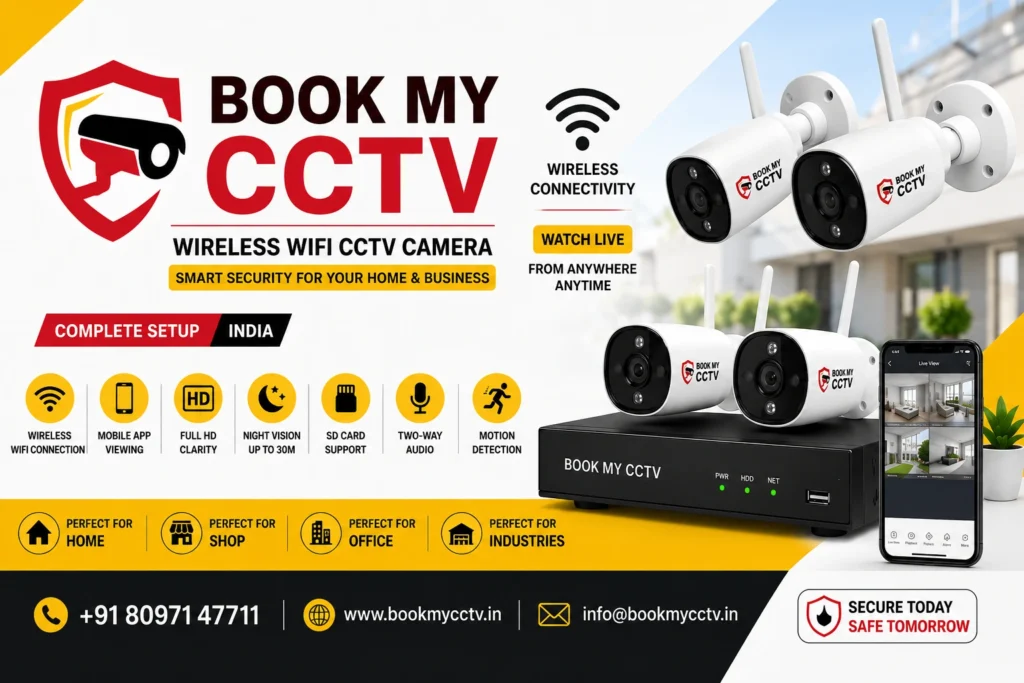
In contrast, a wireless CCTV camera connects directly to your Wi-Fi network. It sends video wirelessly. You can view live footage and receive alerts directly on your smartphone using the camera’s mobile app. Key facts about wireless cameras:
- Still needs a power cable it is “wireless” for video data only. Each camera needs electricity via a socket or adapter.
- Footage is stored on a micro SD card inside the camera or on the cloud (a monthly/yearly subscription may apply).
- Works best in rooms with strong Wi-Fi signal (within 10-15 metres of your router ideally).
- Top Wi-Fi camera brands in India: IMOU, CP Plus ezyKam+, Hikvision, Dahua, and Ezviz.
- Furthermore, setup is very easy In fact, most people can do it themselves. in under 10 minutes using a smartphone app.
Wireless vs Wired CCTV: 10 Key Differences
POINT 1 :- VIDEO RELIABILITY
For wired systems, the cable connection is stable and uninterrupted.
video. No interference from other devices or networks.
Wireless systems can drop or go offline if the Wi-Fi signal is weak.
Wi-Fi signal is weak or congested.
Winner : Wired
POINT 2 :-INSTALLATION DIFFICULTY
Wired systems need drilling and cable routing. Therefore, a trained technician is usually required. Takes 3–5 hours for a 4-camera
system. Not practical for rented homes.
Wireless : Plug into power socket, open the app, scan QR code.
Done in 10–15 minutes. No technician needed.
Best Choice: Wireless
POINT 3:-WORKS WITHOUT INTERNET
In wired systems, the DVR or NVR records to a hard drive continuously,
even when your internet or power is down (with UPS).
This is critical for police evidence in India.
Wireless : NO. If your Wi-Fi goes down, the camera cannot
send footage anywhere. No recording to local storage
unless you have an SD card installed.
Winner : Wired
POINT 4:-REMOTE MOBILE VIEWING
Wired systems let you view all cameras through your DVR/NVR app.
you can view all cameras on apps like Hikvision
Hik-Connect or CP Plus iCSee from anywhere.
Wireless cameras also support mobile viewing through their own apps,
(IMOU Life, iCSee). Very easy to use.
Result: Both (Wireless slightly easier to set up)
POINT 5:-VIDEO QUALITY
In terms of quality, wired systems go up to 4K, for IP cameras. Even analog HD
gives excellent 1080p–5MP quality.
By contrast, wireless cameras are usually 2MP–3MP. Some premium models go up to 5MP but are more expensive.
Winner : Wired
POINT 6:-COST
Wired : Higher upfront. 4-camera IP system with NVR,
HDD, and installation: ₹18,000-₹35,000.
Analog DVR setup: ₹12,000-₹22,000.
Wireless : Lower entry cost. 2 Wi-Fi cameras: ₹3,000-₹8,000.
No NVR, no HDD, no installation cost.
Winner : Wireless (for initial budget)
POINT 7:-STORAGE & FOOTAGE HISTORY
Wired : Hard drive stores 15-60 days of footage depending
on HDD size and number of cameras. No monthly fee.
Footage is 100% private on your premises.
In contrast, wireless cameras rely on SD cards or cloud storage. Cloud storage is
continuous but may require subscription (₹200–
₹1,000/month depending on brand and plan).
Winner : Wired (more storage, lower long-term cost)
POINT 8:-TAMPER & THEFT RISK
Wired : Cameras are fixed, cables are hidden in walls.
Very hard to remove or tamper with.
Wireless : Cameras can be physically moved, unplugged, or
even blocked by simply switching off the Wi-Fi
router something a smart intruder might try.
Recommended Option: Wired
POINT 9:- WEATHER & OUTDOOR USE
Wired : Most outdoor wired cameras are IP66 rated
fully dustproof and protected against heavy rain.
Excellent for Mumbai monsoon conditions.
Wireless : Outdoor Wi-Fi cameras are available (IP66 rated)
but are more expensive and signal can weaken in
heavy rain.
Winner : Both (check IP66 rating on whichever you choose)
POINT 10 :-SCALABILITY
Wired : Easy to expand just add more cameras to your
existing NVR/DVR. 4-channel NVR supports 4 cameras;
8-channel supports 8, and so on.
Wireless : Each camera is independent. Adding more cameras
means more devices competing for Wi-Fi bandwidth.
Can slow down your home internet.
Winner : Wired
Wireless vs Wired CCTV for Indian Homes
This is where most international guides miss the mark. In fact, India has unique conditions that affect which CCTV system works better.
FACTOR 1 :-POWER CUTS (LOAD SHEDDING)
If your area experiences regular power cuts:-
- Wired NVR/DVR systems can use a UPS battery backup. This keeps recording during power cuts. As a result, Indian homeowners are less likely to lose important footage.
- However, wireless cameras lose power when the socket goes. As a result, the footage gap cannot be recovered.
Verdict: Wired + UPS is safer in power-cut-prone areas.
FACTOR 2:- MUMBAI MONSOON & HUMIDITY
Moreover, heavy rain from June to September is a real challenge for outdoor cameras. Look for:-
- IP66 rating (protects against rain and dust)
- Metal housing (not plastic) for heat and humidity resistance
- Avoid placing Wi-Fi cameras too close to the outdoor boundary as rain can cause signal interference.
Fortunately, both wired and Wi-Fi cameras are available with IP66 ratings.
FACTOR 3 :-INTERNET QUALITY & SPEED
However, wireless cameras consume bandwidth typically 1–4 Mbps per camera for HD streaming. If you have:
- 4G-only mobile broadband that cuts out sometimes: wired is far more reliable.
- 50 Mbps+ fibre connection (Jio, Airtel, BSNL): Wi-Fi cameras will work well.
- Multiple family members streaming/working from home: adding 4+ wireless cameras can noticeably slow down your internet.
Best Choice for Renters
FACTOR 4:-RENTED FLATS (VERY COMMON IN MUMBAI)
In addition, millions of people rent homes across Mumbai, Pune, and Bangalore. Landlords often refuse permission for drilling and wall work.
- Therefore, wireless cameras are usually the only practical option for renters.
- In addition, you can take the cameras with you when you move.
- As a result, there is no damage to walls or fixtures.
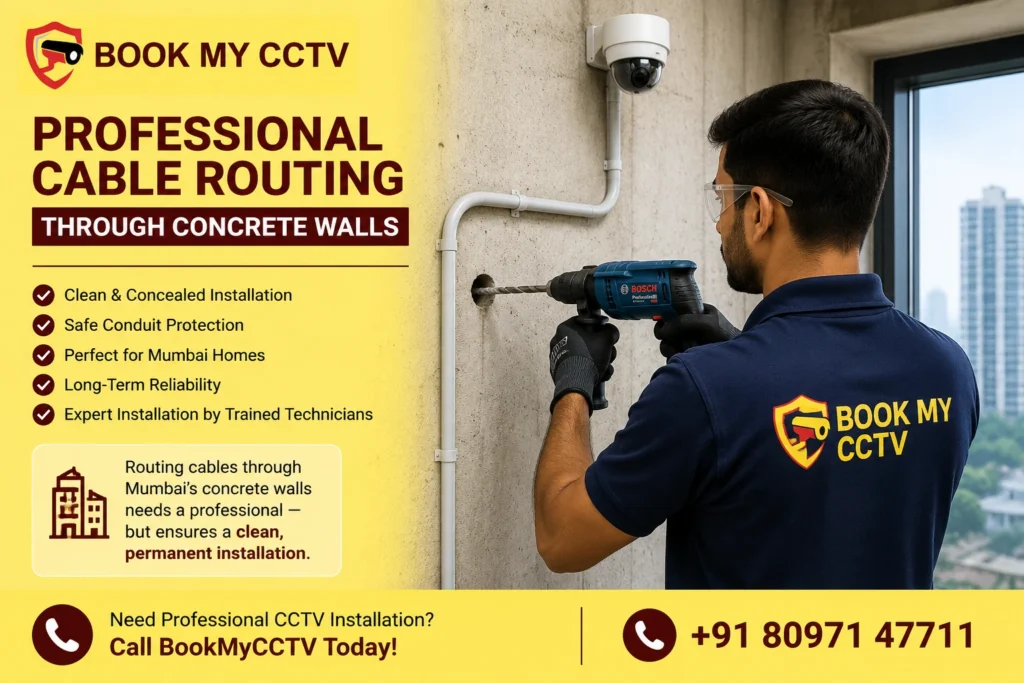
FACTOR 5:-CONCRETE WALLS
Furthermore, unlike Western homes with drywall. Indian construction uses reinforced concrete everywhere. Drilling cable channels through concrete is harder, more time-consuming, and adds to cost.
- Budget ₹500–₹1,500 extra per room for cable routing in Mumbai’s concrete buildings.
- Always use a professional installer DIY drilling in Mumbai apartments can damage structural integrity.
Wireless vs Wired CCTV Pros and Cons
WIRED CCTV-PROS
- Most importantly, it works even when the internet is down.
- Continuous 24/7 recording on hard drive
- Higher video resolution (up to 4K)
- More secure cables cannot be cut easily
- 30–60 day storage capacity with large HDD
- No monthly cloud subscription fees
- Additionally, you can add more cameras as your security needs grow.
- AI features (face detection, line crossing alerts)
- Footage accepted as legal evidence in India
WIRED CCTV – CONS
- Requires professional installation (drilling, cables)
- Higher upfront cost (₹12,000-₹35,000+ for 4 cameras)
- Not practical for rented homes
- Needs UPS for power cut protection
- DVR/NVR needs dedicated space in home/office
WIRELESS CCTV – PROS
- No drilling or cable work needed
- Very easy DIY setup (under 15 minutes)
- Lower entry cost (from ₹1,449 per camera)
- Perfect for renters take cameras when you move
- Great mobile app experience
- Works across multiple locations (home + office)
- Modern, stylish design fits any interior
- Two-way audio (speak through camera)
WIRELESS CCTV — CONS
- Depends on Wi-Fi no internet = no footage
- Limited storage (SD card or paid cloud)
- Can be unplugged or blocked by intruder
- Multiple cameras strain home internet speed
- Less suitable for outdoor use in heavy rain areas
- Monthly cloud storage costs add up over time
Wireless vs Wired CCTV: Which Is Better for Indian Homes?
Wireless vs Wired CCTV for Renters and Homeowners
- FOR OWNED 2BHK / 3BHK APARTMENT IN MUMBAI
Best Choice: Wired 4-camera IP system with NV
Why: Since you own the property, drilling is not an issue. Therefore, a wired system becomes a practical long-term solution. 4 cameras cover front door, living room, kitchen/back exit, and parking or balcony. NVR records 24/7 to HDD. View on Hik-Connect or iCSee from anywhere.
Approx cost: ₹18,000 – 28,000 (installation included)
2. FOR RENTED FLAT IN MUMBAI
Best Choice: 2 Wi-Fi cameras (one at door, one inside)
Why: Since no drilling is required, there is no conflict with landlords. In addition, the cameras can be moved easily when you relocate. Easy to set up and uninstall. IMOU Cue 2E or CP Plus CP-E11A are ideal plug in, set up in 10 minutes, move them when you shift to a new flat.
Approx cost: ₹3,000 – ₹6,000
3. FOR SHOP / RETAIL STORE IN MUMBAI
Best Choice: Wired analog/IP cameras with DVR/NVR
Why:Therefore, shops need continuous recording. Footage may be needed for police complaints, insurance claims, or staff accountability. Wired is non-negotiable. 4–6 cameras: entrance, cash counter, back room, storeroom.
Approx cost: ₹20,000 – ₹45,000
4. FOR OFFICE IN MUMBAI (10–50 EMPLOYEES)
Best Choice: Hikvision IP cameras with 8-channel NVR
Why: Multiple zones need coverage. AI features help monitor access and detect unusual activity after hours. PoE cameras mean a clean, single cable setup.
Approx cost: ₹35,000 – ₹75,000
5. FOR HOUSING SOCIETY / BUILDING COMMON AREAS
Best Choice: Wired IP cameras (Hikvision DeepinView or CP Plus illumax) with central NVR
Why: Society cameras are semi-permanent and must work 24/7. Therefore, a wired system is usually the better choice. Footage from common areas is often needed for police. 8–16 cameras for a typical Mumbai society.
Approx cost: ₹40,000 – ₹1,50,000+

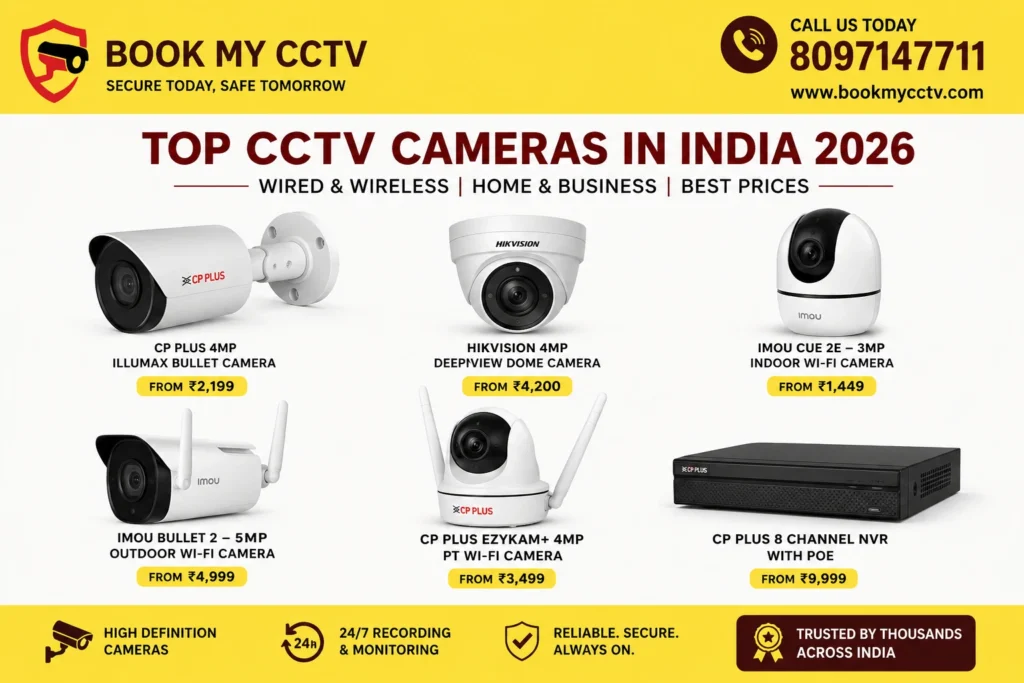
TOP PICKS FROM BOOKMYCCTV
TOP WIRED PICKS
CP Plus 4MP illumax Bullet Camera (CP-UAC-TC24PL5-CS)
Best for: Home exteriors, entrance, parking
Resolution: 2.4MP | Night vision: Dual-light color
Works with: CP Plus DVR / any HD CVI DVR
Price: From ₹2,199 per camera
Shop: http://bookmycctv.com/product-category/camera/
Hikvision 4MP DeepinView Dome Camera
Best for: Offices, shops, indoor use
Resolution: 4MP | Night vision: DarkFighter
Works with: Hikvision NVR (PoE)
Price: From ₹4,200 per camera
Shop: http://bookmycctv.com/product-category/hikvision/ For detailed camera specifications, you can also visit the official Hikvision website. https://www.hikvision.com/
CP Plus 8-Channel NVR with PoE (CP-UNR-0801X1-H)
Best for: 4–8 camera home or small office system
Features: H.265+, PoE ports, HDD up to 10TB
Price: ₹9,999
Shop: http://bookmycctv.com/product-category/network-video-recorder-nvr/
WD Purple 2TB Surveillance HDD
Best for: DVR / NVR storage (stores ~30 days, 4 cameras)
Price: ₹7,899
Shop: http://bookmycctv.com/product-category/hard-drives-hdd/
TOP WIRELESS PICKS
IMOU Cue 2E — 3MP Indoor Wi-Fi Camera
Best for: First-time buyers, rented flats, single rooms
Features: AI human detection, SD card, IMOU Life app
Price: ₹1,449
Shop: http://bookmycctv.com/product-category/imou-cameras/
CP Plus ezyKam+ 4MP PT Wi-Fi Camera (CP-E48Q)
Best for: Living rooms, shops, 360° coverage
Features: Pan-tilt, color night vision, iCSee app
Price: ₹3,499
Shop: http://bookmycctv.com/product-category/camera/
IMOU Bullet 2 — Outdoor Wi-Fi Camera (5MP)
Best for: Outdoor use — gates, parking, compound
Features: IP67 waterproof, color night vision, AI detection
Price: ₹4,999
Shop: http://bookmycctv.com/product-category/imou-cameras/
FREQUENTLY ASKED QUESTIONS
Q1. Can a wireless CCTV camera record without internet?
Ans:- A wireless camera with an SD card can record locally even when your Wi-Fi is down. However, you will not receive mobile alerts or be able to view live footage remotely until internet is restored. Some newer models like IMOU Ranger support offline SD recording check before purchasing.
Q2. What happens to my wired CCTV footage during a power cut?
Ans:-Without a UPS (Uninterruptible Power Supply), your wired systemwill stop recording during a power cut. A UPS costing ₹2,500-₹8,000 can keep your NVR/DVR running for 30–120 minutes. For Mumbai’s frequent short power cuts, a UPS is highly recommended.
Q3. Is it possible to mix wired and wireless cameras in one system?
Ans:- Yes. You can use a Wi-Fi camera at an awkward location (like a ceiling corner where cable routing is difficult) alongside a full wired NVR system. You would simply manage them through separate apps. Many Mumbai homes use this hybrid approach.
Q4. Is wireless CCTV footage accepted as police evidence in India?
Ans:-Yes. Clear, time-stamped, unedited footage from both systems can be used as evidence. However, a wired system with continuous 24-hour recording on a hard drive provides a more complete and tamper-proof timeline. For police complaints, wired footage is generally considered more credible.
Q5. Which is better for night vision — wired or wireless?
Ans:-High-end wired cameras (Hikvision DarkFighter series) have superior low-light performance and support color night vision. However, several modern wireless cameras like the CP Plus ezyKam+ 4MP also offer excellent color night vision (dual-light). For most Indian homes, either system provides adequate night visibility. Check for “full-color night vision” or “dual-light” in the specs.
Q6. How many Mbps does a wireless CCTV camera use?
Ans:-Each Wi-Fi camera typically uses 1–4 Mbps when streaming live. For a 2-camera setup, 10 Mbps of internet is more than adequate.For 4+ wireless cameras, ensure you have at least 30 Mbps available for smooth, uninterrupted viewing.
Q7. Can I install a wired CCTV myself at home in India?
Ans:-For analog/DVR systems with surface-mounted cables, a handy homeowner can sometimes do basic installation. However, for IP camera NVR systems or any installation requiring concealed cables through walls (which is standard in Mumbai), we strongly recommend a professional. Poor installation is the number one cause of CCTV systems failing within the first year.
Wireless vs Wired CCTV: Final Verdict
- After comparing every angle in the Wireless vs Wired CCTV debate, here is our verdict for Indian homes in 2026:
- If you own your home, choose wired CCTV. It is more reliable, more secure, and stores more footage. The upfront cost is higher but you pay nothing extra month after month, and your system works regardless of Wi-Fi or internet disruptions.
- If you rent your home, go WIRELESS. For most renters, drilling holes is not practical, in someone else’s walls. Get 1-2 Wi-Fi cameras from IMOU or CP Plus ezyKam+.They give you mobile alerts, live viewing, and decent night vision all for under ₹5,000 and travel with you when you move.
Finally, if you run a business, only WIRED will do. Shops, offices, and commercial properties need continuous,high-quality recording that holds up as evidence. Wi-Fi cameras are simply not built for that job. Call BookMyCCTV for a free site survey and quote
CALL TO ACTION
If you’re still unsure which system is right for your home or business, contact our team for expert guidance.
Talk to Mumbai’s most trusted CCTV experts-for free.
WhatsApp : +91 80971 47711
Call us : +91 80971 47711
Shop online : https://bookmycctv.com/shop-2-0/
We serve : Mumbai, Navi Mumbai, Thane & nearby
We will assess your property, recommend the right system, and give you a transparent quote — no pressure, no hidden costs.