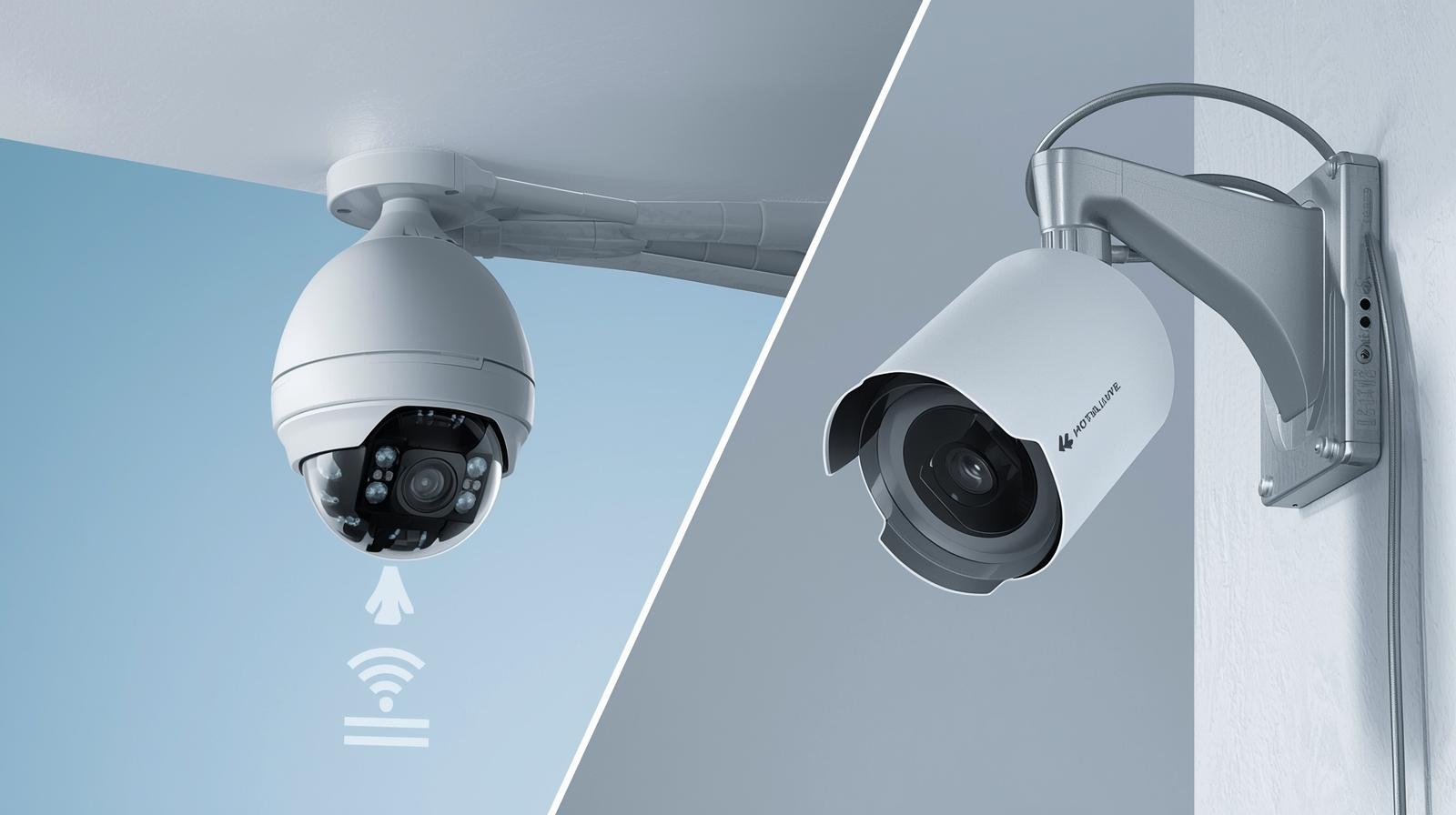
Whether you’re securing your home, office, retail store, or warehouse, one of the first decisions you’ll encounter when buying a security system is:
Wireless CCTV cameras or wired CCTV cameras — which one should you choose?
Both systems have advantages and limitations, and the best choice depends largely on your specific security needs, budget, installation environment, and future scalability.
At BookMyCCTV, we help customers make informed decisions with expert advice, smart surveillance solutions, and professional installation services. In this detailed guide, we compare wireless CCTV vs wired CCTV across multiple factors — from performance and reliability to installation and long-term cost.
By the end of this guide, you’ll know exactly which CCTV system suits your security needs best.
What Are Wired CCTV Cameras?
Wired CCTV systems use physical cables — typically coaxial (for analog) or Ethernet (for IP cameras) — to transmit video and power between the camera and the recording/storage unit (DVR/NVR).
Key Components of Wired CCTV
- CCTV cameras
- DVR (Digital Video Recorder) or NVR (Network Video Recorder)
- Cables (Coaxial or Ethernet)
- Power adapters or PoE switches
These are traditional surveillance systems that have been used for decades — and they remain popular due to their reliable performance and consistent connectivity.
What Are Wireless CCTV Cameras?
Wireless CCTV cameras transmit video and data over Wi-Fi or radio frequencies, eliminating the need for extensive cabling between cameras and the recording unit.
Some wireless cameras still need power cables (unless battery-powered), but the video signal transmission is wireless.
Common Wireless CCTV Setups
- Wi-Fi cameras: Transmit footage using your home or business Wi-Fi network
- Battery cameras: Wireless transmission + battery power
- Wireless kits with base stations: Cameras connect wirelessly to a central receiver
Wireless CCTV technology has advanced rapidly, making it a viable choice for many security applications.
Core Differences: Wireless CCTV vs Wired CCTV
| Feature | Wireless CCTV | Wired CCTV |
|---|---|---|
| Signal Transmission | Wi-Fi / Radio | Physical Cable |
| Installation Complexity | Easy | Requires cabling |
| Reliability | Depends on Wi-Fi strength | Very high and stable |
| Interference Risk | Possible interference | Minimal interference |
| Scalability | Easy to add cameras | Can be complex |
| Best For | Small properties, temporary setup | Large areas, critical security |
| Cost | Lower initial setup | Higher in cabling but stable |
| Maintenance | Battery changes (if battery) | Minimal once installed |
Pros & Cons in Detail
📡 Wireless CCTV Cameras
✅ Advantages
1. Easy & Quick Installation
Wireless cameras are ideal for:
- Renters
- Home security upgrades
- Temporary locations
because they don’t require trenching, drilling, or long cable runs.
2. Flexible Placement
Cameras can be placed where cables can’t easily reach — like:
- High ceilings
- Outdoors without existing wiring
- Remote corners
3. Scalable System
Adding a new camera to a wireless system is simple — just connect to the network and pair it.
4. Remote Monitoring
Most wireless systems offer:
- Mobile apps
- Cloud access
- Push notifications
This makes remote security monitoring very convenient.
5. Aesthetically Cleaner
Without cables everywhere, wireless setups look neater and less intrusive.
❌ Limitations
1. Dependence on Wi-Fi Strength
Signal strength can degrade if:
- Wi-Fi router is far
- Walls and obstacles block signals
- Multiple devices congest network
This may cause lags or dropouts.
2. Possible Interference
Nearby Wi-Fi networks or electronic devices can interfere with signal quality.
3. Power Source Required
Unpowered wireless cameras either need:
- Power outlets nearby
- Battery replacements
4. Security Risks if Not Secured Properly
Wireless signals can be vulnerable if:
- Passwords are weak
- Encryption is not enabled
🔌 Wired CCTV Cameras
✅ Advantages
1. High Reliability
With physical cabling, signal loss and interference are minimal. Wired CCTV systems are perfect for:
- High-security zones
- Large properties
- Critical infrastructure
2. Better Long-Term Performance
Once installed, wired systems rarely fail due to connectivity issues.
3. Stable High-Resolution Video
Wired connections (especially PoE for IP cameras) can handle higher data rates better.
4. Power Over Ethernet (PoE)
Many modern wired systems use PoE, meaning:
- One cable provides power + data
- No separate power supply needed per camera
5. Fewer Vulnerabilities
Wired CCTV doesn’t rely on wireless signals, making it less prone to hacking or interference.
❌ Limitations
1. Complex Installation
Cabling requires:
- Professional planning
- Drilling
- Concealed wiring
This may increase installation time and cost.
2. Less Flexible Post-Installation
Changing camera placement requires new cabling.
3. Higher Upfront Costs
Cables, trenching (if outdoors), and professional labor can increase the initial investment.
Key Factors to Decide Which Is Better for You
1. Security Priority
- High-risk areas (warehouses, shops, offices): Wired recommended
- Low-risk indoor or temporary monitoring: Wireless works well
2. Property Size
- Large properties: Wired CCTV
- Small homes / apartments: Wireless CCTV
3. Installation Environment
- Cable-friendly buildings: Wired
- Rented spaces or difficult‐to-wire walls: Wireless
4. Internet & Power Availability
- Strong Wi-Fi + power points everywhere: Wireless is easier
- Limited or no consistent Wi-Fi: Wired is advisable
5. Scalability Needs
- Regular expansion expected: Wireless offers easy scaling
- One-time setup for long-term use: Wired provides stability
Wireless CCTV Cameras: Best Use Cases
📍 Rental Flats & Apartments – No drilling
📍 Temporary Events – Rapid deployment
📍 Outdoor Areas with Power Outlets – Flexible placement
📍 Remote Monitoring on Mobile – Homes & small offices
📍 Supplement to Existing System – Add wireless cameras anywhere
Wired CCTV Cameras: Best Use Cases
📍 Large Premises & Industrial Areas
📍 High-Security Offices
📍 Shop Fronts & Retail Stores
📍 Critical Infrastructure Sites
📍 Areas with Poor Wi-Fi Signal
Hybrid CCTV Systems: The Best of Both Worlds
In many scenarios, the optimal solution is a hybrid CCTV system — using both wireless and wired cameras together.
When to Use Hybrid Systems
✔️ Wired cameras for critical and high-risk zones
✔️ Wireless cameras for remote corners or temporary focus areas
✔️ Wired backbone + wireless perimeter cameras
BookMyCCTV often recommends hybrid setups because they:
- Maximize coverage
- Balance cost & performance
- Improve scalability
- Offer better reliability than pure wireless systems
Installation Considerations
For Wireless CCTV
- Ensure strong and secure Wi-Fi connection
- Use strong passwords & 2FA
- Position cameras within signal range
- Use cloud backup if available
For Wired CCTV
- Plan cable routes carefully
- Use PoE switches to simplify power/data
- Seal outdoor cable entries
- Test night vision & coverage angles
Cost Comparison (General Overview)
| Cost Category | Wireless CCTV | Wired CCTV |
|---|---|---|
| Hardware | Moderate | Moderate–High |
| Installation | Easy / DIY | Professional Required |
| Cabling | Minimal | High |
| Maintenance | Moderate | Low |
| Expansion | Easy | Requires planning |
(Actual costs vary based on model, location, and installation specifics — BookMyCCTV provides customized quotes.)
Common Myths About Wireless and Wired CCTV
❌ “Wireless CCTV is Always Worse Than Wired”
⚡ Truth: Wireless technology has improved; for many homes, wireless cameras deliver excellent performance.
❌ “Wired CCTV Is Too Outdated”
⚡ Truth: Wired CCTV remains the most reliable choice for critical areas with high security needs.
❌ “Wireless CCTV Is Only for Homes”
⚡ Truth: Wireless can be used in businesses and hybrid setups too.
Expert Recommendation by BookMyCCTV
✔️ Homes & Apartments: Wireless or Hybrid — flexible, affordable, and efficient
✔️ Small Offices & Stores: Wireless with some wired cameras for high-risk spots
✔️ Large Properties & High Security: Wired or Hybrid for stable performance
✔️ Future-Ready Setup: Hybrid CCTV combined with cloud integration
At BookMyCCTV, we evaluate your:
- Property layout
- Security goals
- Budget
- Internet availability
- Expansion needs
and recommend the most effective system tailored for you.
Final Verdict: Which Is Better?
There’s no universal answer — the “best” CCTV system depends on your specific use case.
📌 Choose Wireless CCTV if you want:
✔️ Simple installation
✔️ Remote access & mobility
✔️ Scalability
✔️ Aesthetic setup without cables
📌 Choose Wired CCTV if you want:
✔️ Maximum reliability
✔️ Stable video quality
✔️ No dependence on Wi-Fi
✔️ Long-term performance
📌 Choose Hybrid CCTV if you want:
✔️ Balanced performance
✔️ Best coverage
✔️ Cost-effective scalability
✔️ Flexibility without compromise
Conclusion: Make the Right CCTV Choice With BookMyCCTV
Both wireless and wired CCTV systems have their place in modern security planning. Whether you choose wireless for flexibility, wired for stability, or a hybrid system for optimized security, the key is strategic planning and professional installation.
BookMyCCTV offers expert consultation, customized system design, and professional installation services so you get the right CCTV system for your needs — not just any system.
✨ Secure smarter. Monitor better. Choose BookMyCCTV.